The Astronomy Observation Book Full Edit: A Practical Asset for Stargazing and Publishing
The process of transforming a passion into a tangible product often hinges on practical execution. For astronomy enthusiasts and self-publishing authors, a critical stage in this workflow involves creating the physical or digital vessel for their observations: the journal itself. The Astronomy Observation Book Full Edit addresses this exact point, providing a complete, professionally designed interior template ready for use. It is not just a blank notebook layout; it is a structured tool designed to streamline the final steps of preparing a usable astronomy log for KDP (Kindle Direct Publishing) upload or personal print production.
Integrating a Ready-Made Interior into Your Publishing Workflow
Creating a book from concept to publication involves multiple phases: content creation, design, formatting, and technical preparation. The Astronomy Observation Book Full Edit sits squarely in the design and formatting phase, serving as a foundational asset. Its value lies in removing a significant portion of the technical and aesthetic workload, allowing creators to focus on the substance of their work—the observations, sketches, and data—or on the broader marketing and launch strategy. This integration point is crucial. Instead of spending hours designing page layouts, margins, and observation tables from scratch, a user can import this template as their starting point, ensuring a consistent, polished, and industry-standard format from the outset.
For the independent author or hobbyist, this represents a major efficiency gain. The pack, which includes PDFs for print or upload, a PowerPoint file, PSD, AI, and EPS formats, interacts seamlessly with common creative and publishing tools. A designer might use the Adobe Illustrator (AI) file to tweak graphical elements in a vector-based environment, while a non-designer could simply use the ready-to-go PDFs. This compatibility across platforms ensures that the asset can fit into various user workflows, whether they are deeply technical or prefer a straightforward, no-edit approach.
Practical Application: From Observation Session to Published Log
Consider the typical process of an amateur astronomer who wishes to compile a yearly observing log. The workflow might begin with nightly sessions, using a temporary notebook or digital app for raw notes. Post-session, the task of transcribing and organizing these notes into a permanent, well-formatted book can be daunting. The Astronomy Observation Book Full Edit provides the permanent structure. A user can print the PDFs and bind them for a personal physical log, or they can populate the template with their curated observations and upload it directly to KDP to sell or share. This shifts the effort from structural creation to content curation, a more meaningful and engaging task for the enthusiast.
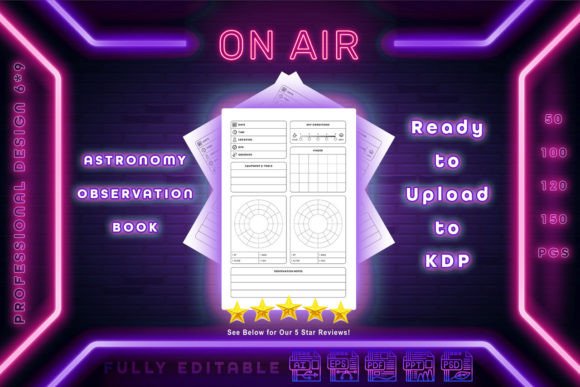
The template’s design, optimized for a 6×9 inch book—a popular and readable trim size—also addresses quality control and usability. Standardized fields for date, time, location, telescope used, celestial object, and observations ensure consistent data entry. This organization is not only beneficial for the individual’s long-term record-keeping but also enhances the reader’s experience if the log is published. A prospective buyer on Amazon expects a clean, functional interior; a professionally formatted observation journal meets that expectation, directly influencing perceived value and sales potential.
Key Features for Implementation and Long-Term Use
Understanding the components of the pack is essential for smooth implementation. The four PDF files are likely variations or complete books ready for immediate use. These are the final output formats. The PowerPoint file offers an accessible way for users to make minor textual adjustments without specialized software. The PSD (Photoshop), AI (Illustrator), and EPS (vector) files are for deeper, graphic-level edits. This layered approach supports different levels of user expertise.
- Preparation: Before using the template, assess your own goals. Do you need a one-off print for personal use? The PDFs suffice. Do you plan to brand a series of observation books with a custom color scheme? The AI or PSD files will be necessary. Having the right file for your specific next step prevents workflow friction.
- Consistency and Branding: For entrepreneurs creating a series of astronomy journals, using the same core Astronomy Observation Book Full Edit template for each volume ensures visual and functional consistency across products. This builds brand recognition and trust with customers.
- Long-Term Asset Utility: Because the files are provided without any watermarks, they become a permanent asset in your digital library. They can be reused, modified for different projects (like a moon phase journal or a deep-sky object log), and integrated into future publishing ventures without recurring costs or licensing concerns.
Workflow Examples for Different User Profiles
The utility of this asset extends across the target audience. A freelance graphic designer working with a client who is an astronomy educator might use the PSD file to quickly customize the interior with the client’s logo and specific header requirements, drastically reducing project time. A blogger focusing on stargazing might use the PowerPoint file to create a simple PDF log to offer as a free download to their community, enhancing their site’s value. A small business owner running a niche publishing imprint can use the AI files to systematically produce a range of observation-themed notebooks, ensuring every product has a professionally formatted interior without in-house design overhead.
In each case, the template acts as a bridge between the creative or observational idea and the finalized, distributable product. It standardizes the complex aspects of book interior design—page margins, bleed areas, font sizing for readability, and structured data tables—which are often hurdles for non-designers. By handling these elements, it allows the user’s energy to be directed towards content, marketing, customer engagement, or simply the joy of documenting the night sky.
Optimizing the Process: Tips for Seamless Integration
To make the most of this resource, approach it as a component in a larger system. Here are practical observations for integration:
- File Management: Upon download, immediately organize the pack into your project folder. Label the files clearly based on your intended use (e.g., “KDP-FINAL.pdf,” “EDITABLE-SOURCE.ai”). This prevents confusion later when you are in the final stages of upload.
- Compatibility Checks: If you plan to edit, briefly open the AI, PSD, or EPS file in your software to ensure it renders correctly before you begin any major work. A quick check confirms compatibility and avoids last-minute technical issues.
- Content First, Format Second: Even with a ready-made format, your primary task is gathering and polishing your astronomical observations. Use the template as the destination for your finalized content, not the workspace for drafting. This maintains a clear separation between content creation and production, leading to a better end product.
- Print Considerations: If printing personally, use the PDF marked for print. Examine it for bleed and margin settings. The 6×9 size is standard, but verify your printer’s capabilities to ensure the output matches the digital design.
Ultimately, the Astronomy Observation Book Full Edit is a tool for implementation. It translates the desire to have a structured observation log or to publish one into an executable task. By providing a complete, watermark-free, and multi-format package, it reduces the barriers of technical design knowledge and software investment. For the productivity-minded user—whether a professional publisher, an educator creating classroom resources, or a hobbyist documenting their journey—it represents a practical step in a process, turning planning and observation into a concrete, usable, and potentially marketable book.